Volunteers, Not Vendors: What Iceland's Rescue Culture Offers American Climbers
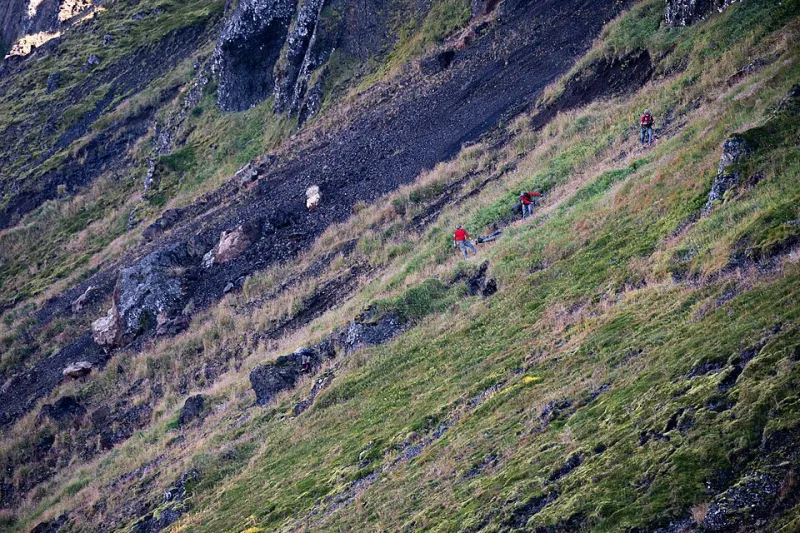
Photo: U.S. Air Force photo by Senior Airman Edgar Grimaldo, Public domain, via Wikimedia Commons
On a wind-scoured ridge in Iceland, the person who arrives to help may be a teacher, a fisherman, or a farm mechanic who has trained with the local rescue group for years. That image is not a fantasy of a simpler world. It is a description of a small-island system in which rescue is understood as a community responsibility rather than a service purchased after an accident. For American climbers accustomed to a patchwork of federal, state, county, and volunteer agencies—sometimes with cost recovery, sometimes without—the Icelandic model is not a template to import wholesale. It is a mirror for habits that travel well.
A Small System With Large Habits
Iceland's search-and-rescue culture is built on small communities, high volunteer participation, and prevention-first thinking. The country's rescue groups are often volunteer-based and closely tied to local knowledge of weather, terrain, and access. That does not mean the system is casual. It means the social distance between the climber and the rescuer is short. The person giving advice at the trailhead may be the same person who would be called out at midnight. In the United States, that distance is often longer: a climber may never meet the sheriff's deputy, park ranger, or volunteer team that would respond to an incident. The Icelandic habit worth borrowing is not the size of the system. It is the assumption that conditions are a shared responsibility.
Prevention Is the First Rope
In Iceland, prevention is not a slogan attached to a warning sign. It is the first layer of the rescue system. Travelers are expected to leave plans, check weather and road conditions, and respect closures. Climbers are expected to understand that a forecast can change faster than a route description. American climbers already know these rules in theory, but the Icelandic approach makes them social: a plan is something you share with people who will notice if you do not return. That is a practical standard. Leave an itinerary with someone who will act on it. Name the latest return time. Identify bailout points. Ask locals about conditions rather than treating a guidebook as a season-long authority.
The Volunteer Dividend
Volunteer rescue culture creates a different kind of accountability. When the team that might rescue you is made up of neighbors, the relationship begins before the emergency. American climbers can support that relationship even where the structure differs. They can donate to local search-and-rescue groups, respect call-outs, train in basic rescue and first aid, and avoid treating agencies as vendors who owe a heroic response. In the United States, volunteer teams operate alongside professional agencies in places such as New Hampshire's White Mountains, Colorado's high country, and the Pacific Northwest. The Icelandic lesson is to see those teams as part of the climbing community, not as a distant safety net.
What Does Not Transplant
The Lower 48 is not Iceland. Jurisdictions are layered. Distances are vast. Liability, funding, and dispatch systems differ from state to state. Cell coverage is uneven, and a rescue in Alaska may involve a very different set of agencies than a rescue in the Adirondacks. A small-island model cannot be copied wholesale, and American climbers should be wary of anyone who claims it can. The point is not to replace agency-driven systems with volunteer enthusiasm. The point is to borrow the habits that make any system work: clear trip plans, early calls for help, local knowledge, and humility about conditions.
Borrowing the Habits, Not the Structure
A useful adaptation is a short pre-trip routine. Write a plan that includes route, bailouts, communication method, and latest return. Share it with someone who knows how to call for help. Ask a local guide or rescue volunteer about current conditions, not just the forecast. Carry the equipment you would need to spend an unplanned night out. Set a turnaround time and treat it as a commitment. If something goes wrong, call early rather than waiting for certainty. And after the trip, debrief honestly: what worked, what was luck, and what would you change. For an archive rooted in Iceland, the rescue model is not background color. It is part of the climbing culture that produced the expeditions. American climbers can honor that culture without pretending the island fits inside the Lower 48.